Leslie’s Restructuring, Pentair’s 18% Sales Drop, The Safety Cases Pool Pros Cannot Ignore


Streamline Your Pool Service Business
PoolDial is AI-powered software that handles scheduling, routing, invoicing, and customer communication. Spend less time on paperwork, more time servicing pools.
Learn MoreLeslie’s Bankruptcy Is Really a Test of the Retail-Service Ecosystem
Leslie’s Pool Supplies has begun a restructuring intended to eliminate roughly **$685 million in debt** and bring in **$60 million of new investment**, with existing lenders expected to take majority ownership. Former executive **Steven L. Ortega** is slated to return as chief executive, and the company is targeting an emergence from bankruptcy in January 2027. For independent service companies, the immediate temptation is to treat this as somebody else’s balance-sheet problem. That would be a mistake. Leslie’s remains one of the industry’s most visible consumer-facing brands, a major seller of chemicals and replacement equipment, and—depending on the market—a source of both referrals and price competition. A leaner balance sheet could give the company room to invest in stores, digital tools and customer retention. But bankruptcy also tends to mean tighter purchasing, store rationalization and a sharper focus on profitable customers. The larger lesson is that the pool business is not immune to the post-boom hangover. Retailers and distributors built capacity around unusually strong pandemic-era demand; now they are sorting through the consequences. Service firms should use the moment to clarify what they offer that a retail counter cannot: reliable field diagnosis, documented water care, equipment accountability and a technician who knows the property. This is worth reading for any operator who buys from, competes with or receives leads from Leslie’s. The headline is not the whole story; the ownership shift matters.
Source: Service Industry News
Pentair’s 18% Decline Shows the Channel Is Still Clearing Its Shelves
Pentair reported an **18% year-over-year decline** in third-quarter pool-business sales, driven largely by distributors reducing orders while they work through excess inventory. That distinction matters. It does not necessarily mean homeowners suddenly stopped needing pumps, filters, heaters and automation systems. It means the equipment channel bought too much inventory earlier and is now correcting. For service companies, this can create an odd operating environment. A manufacturer’s reported sales may be down even while a technician still encounters a steady flow of failed pumps and aging heaters in the field. But the correction does tend to lengthen sales cycles. Customers are more likely to postpone elective upgrades, distributors are more conservative with stock, and manufacturers have less room for broad price increases. The practical response is not to wait for the market to “come back.” It is to improve the replacement conversation. Document energy use, repair history, warranty status and lead times. Give customers a clear repair-versus-replace comparison before the equipment fails in July. Pentair’s number is useful because it confirms what many operators have felt: the industry is moving from scarcity and urgency toward a more price-conscious, inventory-disciplined market. Read this if equipment replacements represent a meaningful share of your revenue; skip it if you are looking for a detailed earnings analysis, because the headline captures most of the reported facts.
Source: Service Industry News
A Filter Lid in Florida Is a Reminder That Pressure Is Not a Minor Hazard
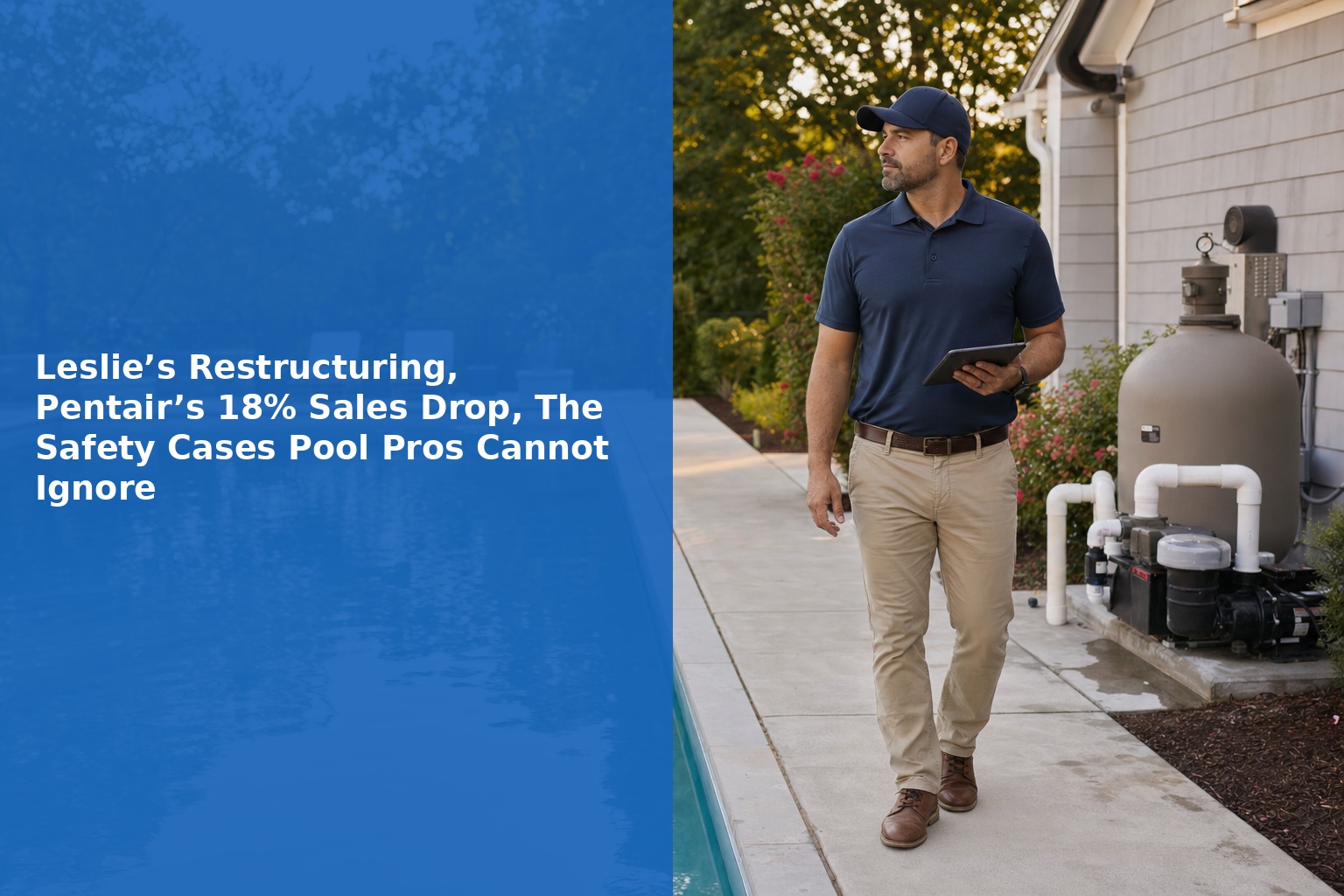
A pool technician in Charlotte County, Florida, suffered multiple facial fractures after a pressurized filter lid blew off and struck him. The incident is blunt evidence of a familiar but too-often-routine risk: a filter tank is not merely plumbing. Under pressure, it is stored mechanical energy looking for an exit. The safety procedure is simple to describe and easy to shortcut on a busy route: shut off the pump, isolate the system where appropriate, open the air-relief valve, verify pressure is at zero, and do not loosen a clamp or lid until the system is fully depressurized. The difficulty is cultural. Experienced technicians can become comfortable around equipment precisely because they have opened hundreds of filters without incident. That is when checklists matter most. This is one of the week’s essential reads for every service owner and field technician—not because it offers novel technical insight, but because the consequence is so severe. Review manufacturer-specific procedures during the next safety meeting. Inspect clamps, O-rings, lids and pressure gauges. And make it explicit that no technician will be penalized for taking the extra minutes required to make a system safe. A rushed filter cleaning is not productive if it ends with an ambulance, a workers’ compensation claim and a technician who may never return to the field.
Source: Pool Magazine
The Carnival Lawsuit Turns Spa Logs Into Evidence
Carnival faces a lawsuit alleging that a passenger contracted Legionnaires’ disease after using a shipboard tidal pool and whirlpools. A trial is potentially scheduled for **April 2027**. The case turns on questions that should be uncomfortably familiar to anyone responsible for high-use spas: Was disinfection adequate? Were water conditions monitored? Were corrective actions documented? Did the operator know—or should it have known—about a risk? Legionella bacteria thrive in warm water systems, and spas present a particularly demanding environment: elevated temperatures, heavy bather loads, complex plumbing and aerosol-producing jets. The issue is not simply whether a test kit produced an acceptable chlorine reading at one moment. It is whether the entire system—circulation, filtration, disinfectant residual, pH, cleaning, maintenance and recordkeeping—was managed consistently. Cruise ships are not apartment complexes, hotels, fitness clubs or community pools. But the liability logic travels well. If an incident occurs, operators will be judged not on their intentions but on what they can show. Service firms with commercial accounts should read this closely and revisit their documentation practices: timestamped readings, chemical additions, equipment repairs, closures, retests and communications with property management. The paperwork is not bureaucracy. In a dispute, it becomes the operating history of the water.
Source: Service Industry News
Public Hot Tubs Need Better Customer Education, Not Just Better Chemistry
Service Industry News revisits CDC guidance urging bathers to use test strips to check disinfectant and pH before entering public hot tubs. The advice is sensible, particularly in high-use facilities, though it also exposes an awkward truth: guests should not be the final quality-control department for a commercial spa. Still, customer-facing education has value. A hotel or health-club operator that posts clear rules—shower before entering, avoid use when ill, keep children out of adult-temperature spas, limit occupancy and report cloudy water—reduces both contamination pressure and conflict with guests. The best operators make safe behavior feel normal rather than punitive. For pool service companies, this is an opportunity to sell a more complete commercial-water-care program: visible test logs, staff training, signage, emergency closure procedures and regular review of circulation and chemical-feeding equipment. The chemistry is only one layer of risk management. The physical system, staff behavior and guest expectations matter too. Read it if you maintain hospitality, multifamily or fitness-club spas. For a residential-only technician, the headline tells you nearly everything you need to know. The useful takeaway is the broader one: warm, turbulent water is operationally less forgiving than a backyard pool, and clients should be priced accordingly.
Source: Service Industry News
Electrical Work Has a Clear Boundary, and “I’ve Done It Before” Is Not One
Pumps, heaters, automation panels, bonding systems and equipment pads put pool technicians in frequent contact with electrical hazards. Service Industry News makes the central point plainly: recognizing a problem is not the same as being qualified to repair it. That distinction is commercially important. A technician who notices a scorched wire, repeated breaker trip, damaged conduit, moisture inside a control panel, failed ground-fault protection or questionable bonding has already created value by diagnosing and documenting the issue. The next step may need to be a licensed electrician, not a service-truck improvisation. The cost of crossing that line can include shock, fire, damaged equipment, insurance trouble and a liability claim that makes the original repair ticket look absurdly small. Owners should build referral relationships with electricians who understand pool equipment. It is one of the least glamorous ways to improve a business, but perhaps one of the most useful: customers get a faster path to resolution, technicians have a defensible escalation process, and the company avoids asking employees to work beyond their licenses or training. This is a worthwhile refresher for field leaders and newer technicians. For veterans, it may feel elementary—but elementary safety rules are usually written in the shadow of someone else’s bad day.
Source: Service Industry News
Cold Plunges Are Becoming a Service Category, Not Just a Wellness Accessory
The Cold Standard is recruiting pool and spa professionals to install and service cold-plunge systems as the category expands nationally. The pitch is straightforward: pool technicians already understand pumps, filtration, sanitation, leaks and water balance. But cold plunges are not simply small spas turned down to a lower temperature. They often combine refrigeration, insulated vessels, compact plumbing, digital controls and water-treatment requirements that vary by manufacturer and use case. The technician who treats one as a simple appliance may miss the real operational issue; the technician who treats it as a conventional pool may overcomplicate a small system. The profitable opening is in learning the equipment well enough to offer recurring care, troubleshooting and winterization—or year-round operation—without guessing. This is among the more promising business-development stories of the week, especially for companies in affluent urban and suburban markets where compact wellness equipment fits more easily than a full-size pool. But it is not a reason to chase every shiny object. Before adding cold plunges, ask whether your team can support refrigeration diagnostics, whether manufacturer training is available, and whether the recurring revenue justifies the extra truck stock and callbacks. Read this if you are actively looking for adjacent service lines. Otherwise, keep it on the watch list rather than treating it as a mandate.
Source: Aqua Magazine
The Best Labor Strategy May Be Fewer Stops, Better Pricing and Faster Pay
In an episode of *Between Two Stops*, pool-service leaders **Brett Murdock** and **Flavia de la Fuente** discuss the labor problem from a more useful angle than the usual lament that “good help is hard to find.” Their conversation covers employee-versus-contractor choices, flexible and faster payroll, and the operational value of connecting Skimmer with FieldPay. Murdock describes managing nearly **400 weekly stops**, where visibility into labor cost is not an accounting luxury; it is the difference between a route that looks busy and one that is actually profitable. The companion lesson comes from *Pool People*, where **Carlos Vasquez**, with nearly **30 years in pool service**, argues for premium per-stop pricing, upfront payment, route density and fewer callbacks. That is a better framework for labor than simply trying to squeeze more work from each technician. A route with too many low-margin stops creates turnover, rushed work and customer churn. It is the pool-service equivalent of running a restaurant with every table full and no money left after payroll. These are two of the week’s strongest listens for owners trying to professionalize operations. The technology references are secondary. The core insight is that labor problems are often pricing, scheduling and job-design problems in disguise. A company cannot retain technicians indefinitely on chaotic routes funded by underpriced accounts.
Source: Betweentwostops
Standards, Training and the Quiet Work of Professionalization
The Pool & Hot Tub Alliance is advancing revisions to four ANSI standards involving water conservation, residential spas and aboveground pools, while also naming its **2027 Board of Directors**. Separately, Hayward says its Tampa Training HUB hosted **94 events** and welcomed professionals from **182 companies** in its first seven months. None of this will generate the excitement of a new robotic cleaner or an extravagant backyard photo contest. It is the slower infrastructure of an industry becoming more formal: standards, training facilities, volunteer governance and manufacturer-led education. These efforts shape how equipment is installed, how technicians are trained and, eventually, what customers and regulators expect from a professional service company. The PHTA board announcement itself is mostly organizational news. Unless you are active in association leadership or advocacy, it is not worth reading beyond the headline. The ANSI update deserves more attention, particularly from builders, retailers and service firms that work with spas or aboveground pools. Standards tend to feel remote until an inspector, insurer, attorney or customer asks whether a job met them. The Hayward figure is also notable because it signals demand for hands-on education. In a business where a technician’s judgment often matters more than the equipment manual, training is becoming a competitive advantage—not a perk for the slow season.
Source: Service Industry News
A Dog-Pool Record and Vinyl-Liner Patterns Are Not Market Signals
Doodlepalooza brought **296 dogs** and their owners to Cowabunga Vegas on Sept. 27, earning a Guinness World Records title for the largest dog pool party. It is a cheerful item, and it does raise real operational questions about filtration, organic load, cleanup and disinfection after animal use. But do not mistake it for a meaningful new service vertical. Most residential and commercial operators do not need a canine-aquatics strategy. Likewise, the latest CGT vinyl-liner patterns—Camden Lake Tahoe, St. Ives Avalon, Hidden Vines and Paradise Reef—may be useful visual options for a renovation salesperson. But these are product notices, not industry news. The headline tells you everything you need to know unless you are selecting liner samples for the coming season. There is a useful editorial lesson in both items. The pool business produces an endless stream of novelty: a new pattern, a record-setting event, a feature that photographs well. Those things can be pleasant and occasionally helpful in marketing. They should not distract from the harder work now facing operators: safety systems, disciplined replacement sales, labor economics and changing distribution relationships.
Source: Service Industry News